
Tuesday, 19 April 2011
God bless all who are being received this week
Amidst the greatness of Holy Week, we also have the particular joy of knowing that so many people are being received into the fullness of the Church during these days. Here in England, in addition to those who are joining within the various dioceses, a large number will become Catholics of the Anglican Ordinariate of Our Lady of Walsingham. May I wish them all the most wonderful blessings. There are great adventures ahead!

Friday, 15 April 2011
The St Barnabas Society: £100,000 to Help Ordinariate Clergy
If you have a little money to spare in these straitened times, may I urge you to consider making a donation to The St Barnabas Society? The Ordinariate Portal has just reported that this fine charity has set aside £100,000 to help Anglican clergy who join the Ordinariate of Our Lady of Walsingham.
In the Society's own words:
The website provides a link for online donations for this most worthwhile cause. I should mention that the introductory text is slightly confusing. It refers to making an online payment “to your parish”, but if you click on the link you will see that in fact the payment goes direct to the St Barnabas Society.
In the Society's own words:
The St Barnabas Society, a registered charity, operates in Great Britain and Ireland and exists to provide pastoral and financial help on behalf of the whole Catholic community to former clergy ministers and religious from other churches, who live in Great Britain and Ireland, and who have been led by faith and conscience to come into full communion with the Catholic Church.
The website provides a link for online donations for this most worthwhile cause. I should mention that the introductory text is slightly confusing. It refers to making an online payment “to your parish”, but if you click on the link you will see that in fact the payment goes direct to the St Barnabas Society.
Thursday, 7 April 2011
Measuring God against Goodness
We all have our different ways of tackling the challenges people present to the idea of faith in God. The most usual challenge is surely the problem of evil. I imagine that more than a few of us have encountered this type of criticism from colleagues at work.
The usual form the challenge takes goes something like: “I can’t believe in a God – or a good God – Who would allow such things to happen.”
I think I must leave aside the question of the widely varying phenomena that are generally gathered together under the umbrella word of evil. These deserve a separate discussion. But even considered in its most simple and general terms, I don’t think there can be an all-encompassing and satisfying answer to this kind of question.
Sometimes, however, a little light can be shed on the subject, from an angle.
What is a person actually doing when he asks the “God and evil” question? He may not realise he’s doing it; but he is in fact saying that he believes in goodness. Not simply goodness, but Goodness as an absolute, as a yardstick against which he measures “God” – or his idea of God – and finds Him wanting. In his eyes, “God” falls short when compared with Goodness.
It is not a very great step from this realisation to a further insight: that the critic’s “God” is not the real God. It is a collection of ideas; it is not God at all. In fact, he is not looking high enough, towards what he instinctively knows is there, and acknowledges as the highest thing, and appeals to. The real God is that perfect Goodness in which he himself already believes.
Naturally this does not answer the great conundrum of why God Who is Goodness allows evil to happen. It leaves that hanging in the air, as a distressing mystery; a mystery, however, which is capable of examination in its various manifestations, and thus of a degree of understanding, however imperfect.
The usual form the challenge takes goes something like: “I can’t believe in a God – or a good God – Who would allow such things to happen.”
I think I must leave aside the question of the widely varying phenomena that are generally gathered together under the umbrella word of evil. These deserve a separate discussion. But even considered in its most simple and general terms, I don’t think there can be an all-encompassing and satisfying answer to this kind of question.
Sometimes, however, a little light can be shed on the subject, from an angle.
What is a person actually doing when he asks the “God and evil” question? He may not realise he’s doing it; but he is in fact saying that he believes in goodness. Not simply goodness, but Goodness as an absolute, as a yardstick against which he measures “God” – or his idea of God – and finds Him wanting. In his eyes, “God” falls short when compared with Goodness.
It is not a very great step from this realisation to a further insight: that the critic’s “God” is not the real God. It is a collection of ideas; it is not God at all. In fact, he is not looking high enough, towards what he instinctively knows is there, and acknowledges as the highest thing, and appeals to. The real God is that perfect Goodness in which he himself already believes.
Naturally this does not answer the great conundrum of why God Who is Goodness allows evil to happen. It leaves that hanging in the air, as a distressing mystery; a mystery, however, which is capable of examination in its various manifestations, and thus of a degree of understanding, however imperfect.
Tuesday, 29 March 2011
"I believe": Yes, I, personally, believe
When was it that “I believe” was changed to “We believe” in the Creed? 1975, I think. Well, I have a little confession to make. Ever since then, when saying the Creed at Mass, I have never said “We believe”; I have always continued to say “I believe”.
It was a step too far for me. I just decided I wasn’t going to do it. The Latin original said “Credo”, not “Credimus”, and that first person singular was good enough for me. I remember attending a Lenten retreat that year at the Cenacle in Liverpool. One of my former teachers was there too: a woman full of character, and very forthright in her views. Her attitude to the change was of a “stuff and nonsense” pithiness.
I suppose the translators (Hah!) wanted to emphasise the sense of community at Mass. But in this instance they decided to emphasise it at the expense of accuracy.
Much more importantly and seriously, they took away from each individual in the congregation the sense of personal focus, of personal commitment to the truths professed in the Creed. I cannot possibly speak for a single other person; not one. Nor can they for me. In fact, I shouldn’t be at all surprised if many of those attending disbelieve one or more of the Creed’s statements.
But then, they can’t be said actually to be lying, can they? None of us can. After all, none of them is saying “I believe”. In a sense, “We believe” is meaningless.
Now, after all these years of staging my personal (and probably entirely unnoticed) rebellion, I look forward with joy to this coming Autumn, when each of us stands before the Lord at Mass, and says “I believe”. By the grace of God, may it send a frisson through us, in heart and mind and soul.
It was a step too far for me. I just decided I wasn’t going to do it. The Latin original said “Credo”, not “Credimus”, and that first person singular was good enough for me. I remember attending a Lenten retreat that year at the Cenacle in Liverpool. One of my former teachers was there too: a woman full of character, and very forthright in her views. Her attitude to the change was of a “stuff and nonsense” pithiness.
I suppose the translators (Hah!) wanted to emphasise the sense of community at Mass. But in this instance they decided to emphasise it at the expense of accuracy.
Much more importantly and seriously, they took away from each individual in the congregation the sense of personal focus, of personal commitment to the truths professed in the Creed. I cannot possibly speak for a single other person; not one. Nor can they for me. In fact, I shouldn’t be at all surprised if many of those attending disbelieve one or more of the Creed’s statements.
But then, they can’t be said actually to be lying, can they? None of us can. After all, none of them is saying “I believe”. In a sense, “We believe” is meaningless.
Now, after all these years of staging my personal (and probably entirely unnoticed) rebellion, I look forward with joy to this coming Autumn, when each of us stands before the Lord at Mass, and says “I believe”. By the grace of God, may it send a frisson through us, in heart and mind and soul.
Saturday, 26 March 2011
A Chatty Post
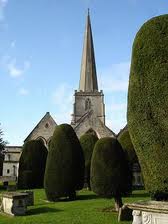
I’m sorry it has been such a long time since my last post. The bronchitis which troubled me recently became so persistent that my GP referred me to a cardiologist. Between the two of them, I have undergone a range of non-surgical tests to make sure my heart is pumping properly, which I’m happy to say it is. The cardiologist is now going to hand me over to a lung specialist, so there is more fun in store for me. As the weeks progress I am gradually feeling better, and am able to get out and about with no difficulty.
We have been having glorious weather. Yesterday I went on the bus to the lovely little Cotswold town of Painswick. It was for a sad reason: the Requiem Mass of a person who was well-known and highly respected, involved in many interests and remembered with great affection by all who knew her. The small Catholic church was packed for the occasion.
As I made my way to the Catholic church, a wonderful peal of bells rang out from the nearby Anglican parish church. There is something rather magical about the musicality of English church bells. The traditional skill attracts ringers of many faiths and none. I was not surprised to learn during the Mass that the deceased had been a member of the team and that the bells had been rung specially in her honour.
Many of you may know that Painswick Church, pictured above, is one of the most famous in the Cotswolds; beautiful in itself, and famed also for the amazing number of clipped yew-trees in the churchyard. Some have grown so close to one another that they have been allowed to form arches. I seem to recall a saying that every time an attempt is made to count the yews a different total results.
After the Mass, while waiting for the return bus, I found the sun so warm that I took off my coat. I sat on the bench, listening to a blackbird singing from a tree in the churchyard, and enjoying what seemed more like a pleasant summer’s day instead of only the 25th of March, the Feast of the Annunciation, with the clocks still on winter time. An unexpected pleasure on a poignant day.
I hope to post again in a few days’ time, all being well.
Wednesday, 16 March 2011
A Suggestion for Nibblers in Lent: Mini-fasts
Reluctant to commit this to the blogosphere, because I don’t know whether or when my determination will crack. Ah well, here goes.
The usual self-denials for Lent - sweets and so on - are real sacrifices for many of us, and well worth undertaking. But this year, in addition, I thought I might try another little Lenten thing: mini-fasts.
Mini-fasts are really only suitable for nibblers. It’s a very simple idea: a resolution to avoid eating between any particular meal and the next; or to avoid eating anything after the evening meal. Any permutation on this could be offered up: it doesn’t have to be for the whole of Lent, or even for an entire day. It could be, for example, from breakfast to lunch; or on this particular day and not others. It could be tailored to individual needs, and the demands of our daily lives. And each mini-fast could be offered up in its own right.
Just a thought.
The usual self-denials for Lent - sweets and so on - are real sacrifices for many of us, and well worth undertaking. But this year, in addition, I thought I might try another little Lenten thing: mini-fasts.
Mini-fasts are really only suitable for nibblers. It’s a very simple idea: a resolution to avoid eating between any particular meal and the next; or to avoid eating anything after the evening meal. Any permutation on this could be offered up: it doesn’t have to be for the whole of Lent, or even for an entire day. It could be, for example, from breakfast to lunch; or on this particular day and not others. It could be tailored to individual needs, and the demands of our daily lives. And each mini-fast could be offered up in its own right.
Just a thought.
Tuesday, 15 March 2011
The Suffering of the People of Japan

After the bout of bronchitis I mentioned in my last post, I am making a rather slow recovery. My brain is at last starting to focus again, and I hope to post again very soon; but overwhelmingly at present my thoughts are with the poor people of Japan, and the series of calamities that have been bludgeoning them. I am filled with admiration for their dignity in the face of so much horror.
(The picture of Our Lady Of Akita has been copied from the blog of The Impractical Catholic, with my acknowledgments and thanks.)
Saturday, 19 February 2011
Summorum Pontificum: Milanese Seminarians Speak Out
Much to my frustration, a nasty spell of bronchitis has prevented me from going to the Mass and study day for the new Mass translation publicised in my previous post.
While needing to stay at home and rest, I have occupied some of my time in translating a very touching open letter from a number of seminarians in the Archdiocese of Milan, home of the Ambrosian rite which features in the latest disturbing rumours concerning the forthcoming Summorum Pontificum regulations.
The letter appears today in Messa in Latino, linked here. The comments that follow it - which I have not translated - start with a criticism of the seminarians' anonymity. Others consider the criticism to be unreasonable given the pressures under which they labour.
I think the letter is very inspiring. Here it is:
"Most Blessed Father, Dear Readers,
We desire the Motu Proprio in Milan, and we want it in the Seminary too, where, in contrast, we are given protestantising liturgies in the “BOSE” style.
Holy Father, Your Eminences, Your Excellencies, all the faithful, come and see how they celebrate in the Seminary of Milan, the liturgical furnishings of our chapel, the so-called statue of Our Lady (in a state of undress, seated before the Tabernacle in a sensual pose!). Please be aware of it. We well understand that times change, that history changes, but the hearts of the people need eternal answers; they need a Truth that is always the same: Jesus Christ, the same yesterday, today and forever.
Why, as Catholics and as seminarians, can we not be formed in the knowledge of the two-thousand-year Tradition of the Church? We are not asking for the old rite to be imposed. We accept that it should remain as the extraordinary form. But why can we not study it officially, and celebrate and pray it occasionally, rather than doing so secretly, clandestinely, without the knowledge of the Rector and the spiritual Father, at night, in our rooms, as though it were an act of disobedience to the Church?
Instead, however, there is imposed a creative liturgical sensibility invented by the community of Bose, which is not our vocation, and is not that for which we chose to follow the Lord in the Catholic Church. We don’t want to be priests in order to live in the Bose style or to celebrate syncretistic rites. Those who have that sensibility are quite free to go to Bose.
We want to be able to chant the Tantum Ergo in Latin (which is against the rules!), and not only the canons of Taizé in English or in Spanish.
Is it possible that a person who thinks like this must live in hiding, keeping silent and pretending that all is well?
What evil is there, we ask, in wanting to be Catholics of the third millennium, evangelizers of our time, and at the same time to be able to pray as the priests and laity of the CATHOLIC Church of Milan have always prayed?
We confirm that we do not want to be absolutist, we do not want an absolute return to the Vetus Ordo rite, but we want real, authentic, non-ideological respect, towards the Church, Her history, Her Tradition, Her spiritual riches which can truly nourish a soul that wants to conform itself to Christ the Priest.
Our thanks go to all of you who keep us in your prayers; those who, like us, seek to follow the Lord, in the furrow of His Church, with our difficulties and our limitations, but illuminated by the splendid grace of our Lord Jesus Christ.
It is our wish that this humble appeal of ours may reach the heart of those who love the Church and who wish to serve the brethren in the things that relate to God.
Saints Ambrose and Charles, intercede for us.
In Jesus and Mary,
Some Seminarians of Seveso
(Metropolitan Archdiocese of Milan)"
While needing to stay at home and rest, I have occupied some of my time in translating a very touching open letter from a number of seminarians in the Archdiocese of Milan, home of the Ambrosian rite which features in the latest disturbing rumours concerning the forthcoming Summorum Pontificum regulations.
The letter appears today in Messa in Latino, linked here. The comments that follow it - which I have not translated - start with a criticism of the seminarians' anonymity. Others consider the criticism to be unreasonable given the pressures under which they labour.
I think the letter is very inspiring. Here it is:
"Most Blessed Father, Dear Readers,
We desire the Motu Proprio in Milan, and we want it in the Seminary too, where, in contrast, we are given protestantising liturgies in the “BOSE” style.
Holy Father, Your Eminences, Your Excellencies, all the faithful, come and see how they celebrate in the Seminary of Milan, the liturgical furnishings of our chapel, the so-called statue of Our Lady (in a state of undress, seated before the Tabernacle in a sensual pose!). Please be aware of it. We well understand that times change, that history changes, but the hearts of the people need eternal answers; they need a Truth that is always the same: Jesus Christ, the same yesterday, today and forever.
Why, as Catholics and as seminarians, can we not be formed in the knowledge of the two-thousand-year Tradition of the Church? We are not asking for the old rite to be imposed. We accept that it should remain as the extraordinary form. But why can we not study it officially, and celebrate and pray it occasionally, rather than doing so secretly, clandestinely, without the knowledge of the Rector and the spiritual Father, at night, in our rooms, as though it were an act of disobedience to the Church?
Instead, however, there is imposed a creative liturgical sensibility invented by the community of Bose, which is not our vocation, and is not that for which we chose to follow the Lord in the Catholic Church. We don’t want to be priests in order to live in the Bose style or to celebrate syncretistic rites. Those who have that sensibility are quite free to go to Bose.
We want to be able to chant the Tantum Ergo in Latin (which is against the rules!), and not only the canons of Taizé in English or in Spanish.
Is it possible that a person who thinks like this must live in hiding, keeping silent and pretending that all is well?
What evil is there, we ask, in wanting to be Catholics of the third millennium, evangelizers of our time, and at the same time to be able to pray as the priests and laity of the CATHOLIC Church of Milan have always prayed?
We confirm that we do not want to be absolutist, we do not want an absolute return to the Vetus Ordo rite, but we want real, authentic, non-ideological respect, towards the Church, Her history, Her Tradition, Her spiritual riches which can truly nourish a soul that wants to conform itself to Christ the Priest.
Our thanks go to all of you who keep us in your prayers; those who, like us, seek to follow the Lord, in the furrow of His Church, with our difficulties and our limitations, but illuminated by the splendid grace of our Lord Jesus Christ.
It is our wish that this humble appeal of ours may reach the heart of those who love the Church and who wish to serve the brethren in the things that relate to God.
Saints Ambrose and Charles, intercede for us.
In Jesus and Mary,
Some Seminarians of Seveso
(Metropolitan Archdiocese of Milan)"
Wednesday, 16 February 2011
Study day for new Mass translation, Clifton diocese, 19th February
I mentioned in an earlier post that the English diocese of Clifton - covering the counties of Gloucestershire, Wiltshire and Somerset - has been rather energetic in its preparations for the introduction of the New Translation of the Mass in September this year.
The series of presentations continues this coming Saturday, 19th February, and this time it is the turn of Cheltenham, at Sacred Hearts Church, Moorend Road, Charlton Kings, GL53 9AU. The day begins with Holy Mass at 10.30, using the new translation, which will be followed by a study session. The event closes at 3.30. Those attending are advised to bring a packed lunch.
On the Friday evening, from 7.30 to 8.30, there will be singing practice for the new parts of the Mass, in readiness for Saturday.
The series of presentations continues this coming Saturday, 19th February, and this time it is the turn of Cheltenham, at Sacred Hearts Church, Moorend Road, Charlton Kings, GL53 9AU. The day begins with Holy Mass at 10.30, using the new translation, which will be followed by a study session. The event closes at 3.30. Those attending are advised to bring a packed lunch.
On the Friday evening, from 7.30 to 8.30, there will be singing practice for the new parts of the Mass, in readiness for Saturday.
Sunday, 13 February 2011
Another strange case
Following my post yesterday, I’d like to record another memory. It concerns Freemasonry, about which Fathers Blake and Zuhlsdorf blogged early in January. Well, it's not really about Masonry as such; it's more about what was going on in the Church in the years following Vatican II.
As I recall (and I hope you will make allowances for some vagueness), exactly the same process occurred in regard to the question of Freemasonry, as had happened some years earlier regarding women’s headcoverings. Something was reported, and it appeared to have come from Rome, the gist of which was that British Catholics were now free to join the Masons
a) because British Masonry was much nicer than the Continental variety, which was very anti-Catholic and still forbidden, and
b) provided that there was no danger that an individual’s faith might suffer by joining.
I don’t know the figures, but I would guess that as a consequence of this apparent relaxation quite a number of Catholic men very soon became members of their local Lodges, and those who were already members now felt more at ease in their consciences.
And then lo! In no time at all, once again there came the cry: “As you were!” Britain is not an exception; you may not join the Masons.
It would surely be impossible to know how many British Catholic Masons obeyed the Church and gave up their membership following this shambles; how many have joined the Masons since then; and, and, most importantly, what effect it has had on their orthodoxy. In some cases they would have been exasperated by this apparent flip-flop, rather like the women with their headcoverings, and resolved to make up their own minds on the matter. But I have the impression that the majority of Catholics in this country, from that time on, only remember the (illusory) relaxation, and take it as read that, in this country at least, Catholics can be Freemasons.
Incidentally, it was at about this time, as I seem to remember, that I first began to hear the comment that this or that pronouncement from Rome “doesn’t apply here.”
As I recall (and I hope you will make allowances for some vagueness), exactly the same process occurred in regard to the question of Freemasonry, as had happened some years earlier regarding women’s headcoverings. Something was reported, and it appeared to have come from Rome, the gist of which was that British Catholics were now free to join the Masons
a) because British Masonry was much nicer than the Continental variety, which was very anti-Catholic and still forbidden, and
b) provided that there was no danger that an individual’s faith might suffer by joining.
I don’t know the figures, but I would guess that as a consequence of this apparent relaxation quite a number of Catholic men very soon became members of their local Lodges, and those who were already members now felt more at ease in their consciences.
And then lo! In no time at all, once again there came the cry: “As you were!” Britain is not an exception; you may not join the Masons.
It would surely be impossible to know how many British Catholic Masons obeyed the Church and gave up their membership following this shambles; how many have joined the Masons since then; and, and, most importantly, what effect it has had on their orthodoxy. In some cases they would have been exasperated by this apparent flip-flop, rather like the women with their headcoverings, and resolved to make up their own minds on the matter. But I have the impression that the majority of Catholics in this country, from that time on, only remember the (illusory) relaxation, and take it as read that, in this country at least, Catholics can be Freemasons.
Incidentally, it was at about this time, as I seem to remember, that I first began to hear the comment that this or that pronouncement from Rome “doesn’t apply here.”
Saturday, 12 February 2011
The strange case of the disappearing headcoverings

In his recent post on the subject, The Catholic Knight reproduced this cutting from The Atlanta Journal, dated some time in 1969. Father Z (here and here) and others have also dealt with the consequences of that strange incident.
I can remember it quite well. At the church I attended in Liverpool, as soon as we women heard the message that we no longer had to cover our heads, off came the hats, scarves and mantillas. The following Sunday, hardly any of the women were covering their heads.
Almost immediately, or so it seems at this distance in time, the word came out: As you were! The law has not changed: women must continue to cover their heads in church. As I recall, it was even announced from the pulpit.
And the majority of us did not comply. I think there was a general – if mainly unspoken – emotional response: This is ridiculous. First you don’t need to wear them, and then you do. It’s just not important. I’ll decide. That was my own decision too. But do you know, I felt just a little bit uneasy about it at the time. There was a niggling voice of conscience.
But gradually the new way became the generally accepted custom. And the requirement was eventually dropped, as a de jure recognition of the de facto practice.
I find great joy these days in covering my head when I attend Mass in the Extraordinary Form. But at my own parish church, I have a real reluctance. For the usual reasons, I suppose: sticking out like a sore thumb, holier-than-thou, and all that. I don’t really know the answer, except more courage; though it’s ridiculous to feel that one needs courage to do something that was completely natural only a few decades ago. I think we would have to be prepared to counter any criticisms with good, positive reasons. An expression of unity with Catholic women in other places and in other times, perhaps.
It would be rather wonderful if the Holy Father, or the competent body in Rome, were to recognise an indulgenced Sacramental, along these lines: that a woman or girl who covers her head before the Blessed Sacrament is empowered to offer this action to obtain a partial indulgence for the Souls in Purgatory.
Wednesday, 2 February 2011
The growth of the Ordinariate movement
Fr Hugh, the vocation director of the Benedictines at Douai Abbey in Berkshire, has a blog called Dominus Mihi Adjutor. He has just published this interesting map of the spread of the Ordinariate movement up to now, in various parts of the world. You will notice that the display does not yet include the proposed Australian/Japanese Ordinariate.
I thought you might also like to see this link to a map of southern England and Wales, which can be found on the Ordinariate Portal, showing the locations of the exploratory Ordinariate groups which have been set up so far in Great Britain.
God bless them all, both groups and individuals, as they make their spiritual journeys.
I thought you might also like to see this link to a map of southern England and Wales, which can be found on the Ordinariate Portal, showing the locations of the exploratory Ordinariate groups which have been set up so far in Great Britain.
God bless them all, both groups and individuals, as they make their spiritual journeys.
Tuesday, 18 January 2011
The new Mass translation, and words of praise for Clifton Diocese
This is going to sound like a mini-Oscar ceremony, but here goes.
Other bloggers have reported the excellent news that the Bishops of England and Wales have decided to introduce the new, more accurate and more dignified translation of the Novus Ordo Mass in September 2011.
The purpose of my post is to praise the Diocese of Clifton in this regard, because it has already done rather well in preparing its people for the change. A series of catechetical days has been organised in various parts of the Diocese. In addition, the parish priest of my own parish has devoted a number of Sundays to speaking to us about the meaning of the various parts of the Mass. I don’t know how many other parishes in the Diocese received the same talks, but I thought it was a very good effort.
I’d also like to compliment Fr Michael Fountaine, the Director of the Diocese’s Department for Liturgy. As far back as two years ago, he delivered a most interesting talk to a group of us in the town where I live. His enthusiasm for the new translation was really heartening.
Well done to Fr Fountaine, to my parish priest, and to Clifton Diocese!
Other bloggers have reported the excellent news that the Bishops of England and Wales have decided to introduce the new, more accurate and more dignified translation of the Novus Ordo Mass in September 2011.
The purpose of my post is to praise the Diocese of Clifton in this regard, because it has already done rather well in preparing its people for the change. A series of catechetical days has been organised in various parts of the Diocese. In addition, the parish priest of my own parish has devoted a number of Sundays to speaking to us about the meaning of the various parts of the Mass. I don’t know how many other parishes in the Diocese received the same talks, but I thought it was a very good effort.
I’d also like to compliment Fr Michael Fountaine, the Director of the Diocese’s Department for Liturgy. As far back as two years ago, he delivered a most interesting talk to a group of us in the town where I live. His enthusiasm for the new translation was really heartening.
Well done to Fr Fountaine, to my parish priest, and to Clifton Diocese!
Saturday, 15 January 2011
So happy ...

Congratulations to A Reluctant Sinner for his fascinating report on the Ordination Mass at Westminster Cathedral today, for the inaugurating priests of the Anglican Ordinariate.
I had hoped to make the journey from Gloucestershire for the event, but was unable to do so because I haven’t been too well this week. I have been waiting with great anticipation for the reports to arrive in the blogosphere.
How lovely, and simple, and fitting, that the name is to be The Personal Ordinariate of Our Lady of Walsingham. I am starting to get a hankering to go there again on pilgrimage.
Wednesday, 12 January 2011
What should we non-Ordinariate Catholics call ourselves?
What if we were to call ourselves Diocesan Catholics? I think I'll do this for now, but I'll be happy to change it, if and when a better name comes along.
In most circumstances, naturally, we need make no distinction at all. I suggest this only because there are likely to be occasions when we will need to draw attention to specifically non-Ordinariate matters which have an equal importance for our Ordinariate Catholic brethren. It would be unthinkable that they might be at risk of missing out on something they might not hear about otherwise.
In most circumstances, naturally, we need make no distinction at all. I suggest this only because there are likely to be occasions when we will need to draw attention to specifically non-Ordinariate matters which have an equal importance for our Ordinariate Catholic brethren. It would be unthinkable that they might be at risk of missing out on something they might not hear about otherwise.
Monday, 10 January 2011
Christmas Flashmob: strong stomachs required
I first picked this up on Andrea Tornielli's blog, then realised it had been sourced from Gloria TV. The occasion was the Vigil Mass for Christmas 2010 at Bachinchove, in northern France. Please follow this Gloria TV link, but be warned ....
As Andrea Tornielli says, they thought they were coming to Mass, and found themselves at a disco.
As Andrea Tornielli says, they thought they were coming to Mass, and found themselves at a disco.
Friday, 7 January 2011
Blessed is the Wood
Here is a beautiful extract from Chapter 14 of the Book of Wisdom, which I read with great delight the other day. I’ve no doubt many readers will already be familiar with it, but I hope you will enjoy being reminded of it. The extract is taken from the Catholic Revised Standard Version.
To set it in its context, the writer is dealing with the foolish worship of idols, such as those made of wood, which are no more than the product of a man’s hands. He contrasts this with the natural properties of the wood, and with the skill that fashions it into something beneficial: in this instance, into a ship. The natural properties, and the human skill, are both genuine expressions of God’s wisdom,
To set it in its context, the writer is dealing with the foolish worship of idols, such as those made of wood, which are no more than the product of a man’s hands. He contrasts this with the natural properties of the wood, and with the skill that fashions it into something beneficial: in this instance, into a ship. The natural properties, and the human skill, are both genuine expressions of God’s wisdom,
but it is your providence, O Father, that steers its course,
because you have given it a path in the sea,
and a safe way through the waves,
showing that you can save from every danger,
so that even if a man lacks skill, he may put to sea.
It is your will that works of your wisdom should not be without effect;
therefore men trust their lives even to the smallest piece of wood,
and passing through the billows on a raft they come safely to land.
For even in the beginning, when arrogant giants were perishing,
the hope of the world took refuge on a raft,
and guided by your hand left to the world the seed of a new generation.
For blessed is the wood by which righteousness comes.
Thursday, 6 January 2011
Archbishop Longley to join the New Evangelisation Council
You may be interested in this item from The Catholic Herald’s website. Archbishop Longley of Birmingham has been appointed to the Pontifical Council for Promoting New Evangelisation. This is the new body headed by Archbishop Fisichella.
Wednesday, 5 January 2011
The standard of knowledge and belief among those who will inaugurate the Ordinariate
May I draw your attention to this marvellous article which has been posted today on William Oddie’s blog on the Catholic Herald website. The following extract is particularly important in view of the surprise and concern expressed in one or two comments on other blogs, at the speed with which the newly-received former “flying bishops” are to be ordained.
What this new development demonstrates, apart from anything else, is the degree of knowledge, gained by the former Cardinal Ratzinger after a decade and a half of discussions with these men, of their already existing understanding of and belief in Roman Catholic doctrine and practice (entirely based, since its publication, on the Catechism of the Catholic Church and on other essential Catholic texts). The Pope is well aware that the Anglo-Catholic clergy who will inaugurate the world’s first ordinariate already have a degree of authentically Catholic priestly formation which some of our seminaries are today far from achieving or even attempting.This makes me think of the idea of enrichment, which the Holy Father’s initiatives have envisaged in the liturgical sphere. It would be a tremendous thing if it could be broadened to include other areas of the Church’s life, such as our seminaries, as an additional fruit of the Ordinariate. It will require a cheerful, humble and fraternal spirit on the part of all who are involved; and especially on the part of those who currently have the task of training our priests.
Saturday, 1 January 2011
Happy 2011 to all, and a glad goodbye to 2010
Very best wishes to all users of the Catholic blogosphere, for a new year filled with blessings. There have been tremendous events in 2010, but things to cause dismay too. All in all, I'm glad it's over and done with. Time now to build on the beautiful things.
Subscribe to:
Posts (Atom)